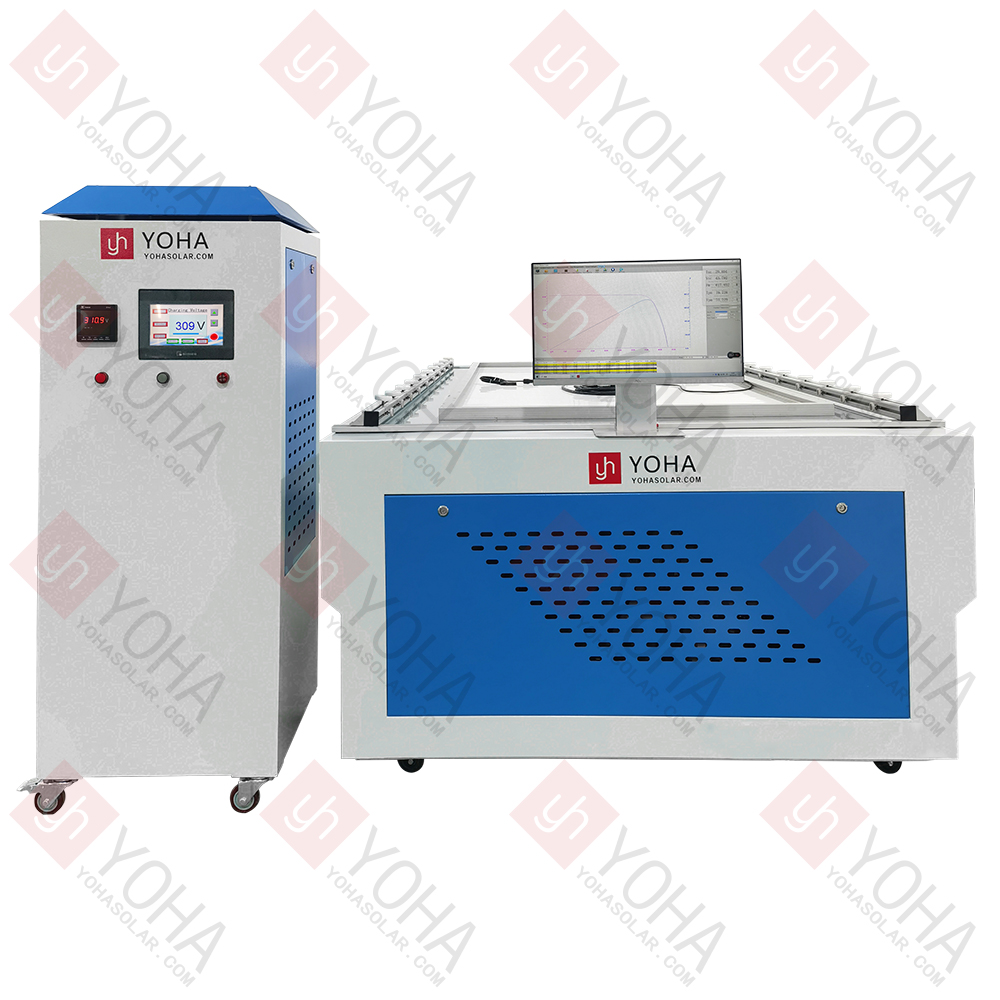
| On the Key Performance Testing Focuses of IV Testers in Photovoltaic Production |
| 发布时间:2025-10-23 14:00:01| 浏览次数: |
In the manufacturing process of photovoltaic modules, the birth of each module carries the commitment to green energy and the pursuit of power generation efficiency. The final, yet most critical, quality checkpoint ensuring the fulfillment of this commitment and pursuit is the photovoltaic module IV tester. It acts as a rigorous "product inspector," providing an authoritative "diagnosis" for the performance of each module by accurately measuring the current-voltage characteristic curve. So, when we use IV testers on the production line, what exactly are the respective focuses? This is by no means a simple reading of individual parameters but rather a multi-dimensional and systematic performance evaluation process. Focus 1: Accurate Capture and Verification of Basic Electrical Parameters This is the cornerstone of IV testing and the primary step in production line quality control. The tester rapidly and accurately measures several core electrical parameters and compares them against the module's design target values.
Through this "physical examination" of the three basic parameters, the production line can quickly screen out severely non-compliant products, ensuring that only "healthy" modules leave the line. Focus 2: Power Calibration and Precise Sorting After confirming the basic performance of the module, the next core focus is power calibration and sorting. This is directly related to the module's market value and subsequent system matching. The IV tester accurately measures the module's maximum output power under simulated Standard Test Conditions (STC). The production line then sorts the modules into different power bins based on the measurement results. The emphasis in this process is on extremely high accuracy and repeatability. Even slight measurement deviations can lead to incorrect binning, causing value loss or customer complaints. Therefore, regular calibration of the tester and strict control of the test environment (such as the stability of the simulated light source and temperature uniformity) are paramount in this step. Precise sorting not only protects customer interests but also provides a reliable data foundation for the system design of photovoltaic power plants, ensuring highly consistent performance among modules within the same string, thereby enhancing the overall power generation efficiency of the plant. Focus 3: Curve Shape Analysis and Potential Defect Diagnosis A perfect IV curve should exhibit a full, smooth rectangular shape. However, curves generated in actual production vary in shape, and these "imperfect" curves are precisely the "codes" for diagnosing internal potential defects. This represents a deeper level of focus for IV testing, moving from "pass/fail judgment" towards "quality analysis."
Through in-depth analysis of the IV curve shape, the production line can not only reject defective products but also trace back problems in the production process, providing valuable data support for optimizing processes like cell soldering and lamination, thereby achieving continuous quality improvement. Focus 4: Importance of Environmental Simulation and Calibration The test results from the IV tester are not generated in a vacuum; their accuracy heavily relies on the simulation of the test environment and calibration. This focus concerns the reliability and fairness of the test results. Testing must be conducted under Standard Test Conditions (STC), primarily including standard irradiance, standard spectrum, and standard module temperature. The solar simulator used on the production line must provide stable, uniform illumination with high spectral match. Simultaneously, precise temperature monitoring and control are crucial, as the voltage characteristics of the module are highly sensitive to temperature. The focus for the tester is to ensure the stability and accuracy of these environmental parameters and to eliminate systematic errors through regular cross-calibration with reference modules, guaranteeing data consistency across different production lines and different time points. Focus 5: Integration of Test Data and Quality Traceability In modern smart factories, the IV tester is no longer an "information island." Its final focus lies in the seamless integration of test data and full-process quality traceability. After testing each module, its complete IV curve data, key electrical parameters, test time, environmental conditions, and other information are automatically recorded and linked to the module's unique serial number. This vast amount of data is uploaded to the factory's Manufacturing Execution System (MES), forming a valuable "quality big data" repository. By analyzing this data, companies can achieve end-to-end quality traceability from raw materials to finished products, quickly identify problematic batches, analyze periodic patterns of quality fluctuations, and provide R&D departments with real, extensive performance feedback, driving product and process innovation. Summary In summary, the use of IV testers on photovoltaic production lines involves a systematic engineering approach that progresses from the surface to the core, from points to aspects. It starts with the accurate verification of basic parameters like open-circuit voltage, short-circuit current, and maximum power, then proceeds to power calibration and fine sorting of modules. It delves into the analysis of the IV curve shape to identify potential internal defects, providing direction for process optimization. It relies on strict environmental simulation and calibration to ensure data fairness and authority. Finally, through data integration with information systems, it builds a closed-loop system for quality traceability and continuous improvement. It is through the comprehensive control of these key focuses that the IV tester truly becomes the "guardian" of photovoltaic module quality, helping companies deliver every efficient and reliable module to the market, laying a solid quality foundation for the global green energy industry. |
| 上一篇:Key Equipment Configuration Points for a 50MW Manual PV Module Production Line 下一篇:Calibration Cycle for PV Module Testers: A Critical Link in Ensuring Accurate Me |