Solar Panel EL + AOI Tester
Solar Panel EL + AOI Tester
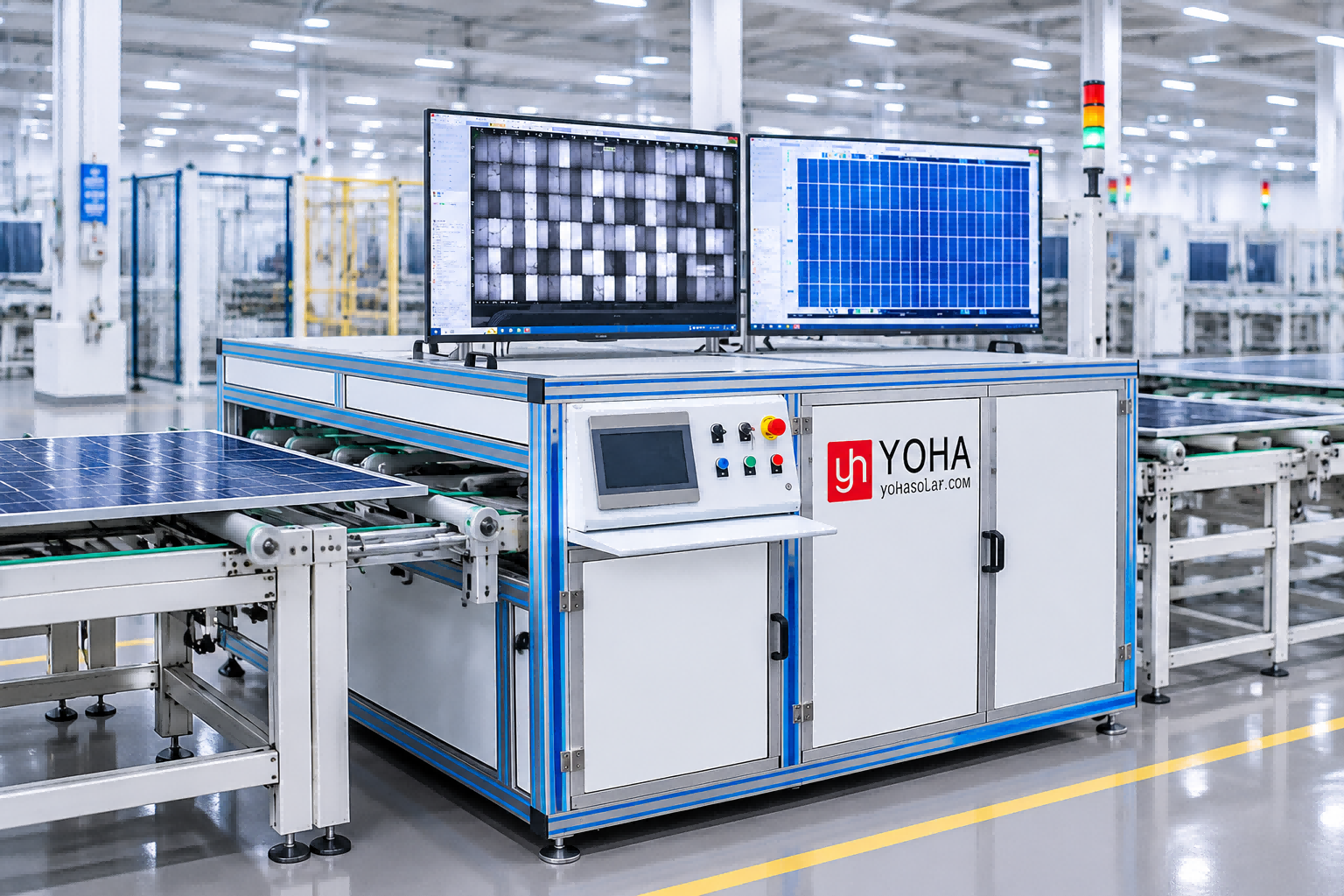
The Solar Panel EL + AOI Tester combines EL imaging and AOI visual inspection to detect internal and external defects in solar panels.
EL Inspection: The module is energized inside a dark chamber, and high-sensitivity cameras capture EL images to identify internal defects such as micro-cracks, broken cells, broken fingers, black cores, and poor soldering.
AOI Inspection: Industrial cameras capture surface images to detect appearance defects such as scratches, dirt, foreign objects, chipped edges, color differences, ribbon misalignment, and visible encapsulation defects.
By combining EL and AOI inspection in one machine, it provides comprehensive quality inspection for solar panels. It is suitable for PV module production lines to improve inspection efficiency, reduce missed defects, and ensure product quality before shipment.
Key Features of Solar Panel EL + AOI Tester
1. Integrated EL + AOI Dual Inspection
Combines Electroluminescence (EL) imaging and AOI visual inspection in one system. EL inspection detects internal cell defects such as micro-cracks, broken cells, broken fingers, black cores, and poor soldering. AOI inspection identifies visible defects such as scratches, chipped edges, dirt, foreign objects, color differences, and ribbon misalignment, providing comprehensive quality inspection before lamination.
2. High-Precision Imaging & Intelligent Defect Detection
Equipped with high-resolution industrial cameras and advanced image processing algorithms to capture EL and surface images. The system automatically identifies, locates, and classifies defects, improving inspection accuracy and reducing reliance on manual inspection.
3. Automated Online Inspection
Designed for integration into PV module production lines before lamination. Supports automatic module inspection and material handling, helping manufacturers improve inspection efficiency, reduce manual intervention, and maintain consistent production quality.
4. Defect Data & Inspection Reports
Automatically records inspection results and generates visual defect reports, providing clear information for quality evaluation, production monitoring, and process improvement. Helps manufacturers identify production problems early and reduce defective modules entering the lamination process.
Technical Parameters
| Parameter | Specification |
|---|
| Model | YH-EL8 |
| Applicable Process | Pre- and Post-Lamination Defect Inspection |
| Applicable Modules | Monocrystalline and Polycrystalline PV Modules |
| Camera Type | Professional Industrial Cameras |
| Camera Resolution | EL: 60 MP / AOI: 24 MP |
| Imaging Configuration | 8-Camera Area-Scan System |
| Detection Sensitivity | Detectable Crack Width: < 0.03 mm |
| Loading / Unloading | Automatic |
| Inspection Mode | Online Automatic Inspection |
| Effective Inspection Area | 2600 × 1500 mm |
| Regulated Power Supply | 60 V / 20 A |
| Image Acquisition Time | 100–700 ms |
| Power Supply | 220 V / 50 Hz |
| Equipment Dimensions (L × W × H) | 3095 × 2220 × 1665 mm |
Product Applications
1. PV Module Production Line Inspection
Installed in the PV module production line before lamination, the YH-EL8 performs automatic EL and AOI inspection of solar modules. It detects internal cell defects and surface appearance issues, helping manufacturers identify quality problems early, reduce defective modules entering the lamination process, and improve production yield.
2. Laboratory Quality Inspection and Analysis
Used in manufacturing laboratories and third-party testing facilities for detailed EL imaging and visual defect analysis of solar cells and PV modules. It supports defect evaluation, process quality assessment, and failure analysis of test samples.
3. Solar Power Plant Quality Inspection
EL inspection technology can be used during solar power plant installation and operation to identify potential module defects, such as micro-cracks, broken cells, and other abnormal conditions. It helps assess module quality and locate defective modules during field inspections. Portable or mobile EL testing equipment is generally used for on-site inspection.
4. PV Research, Development and Quality Testing
Applied in PV research institutions, module manufacturers, and testing laboratories for new product development, material evaluation, process validation, and reliability testing. EL imaging helps analyze cell and module defects before and after environmental aging tests, providing useful data for product improvement and quality assessment.