In the vast wave of global energy transition, photovoltaic (PV) power plants are springing up like mushrooms, becoming a crucial cornerstone of green electricity. PV modules, as the core power generation units of these plants, directly determine the power generation revenue and safety throughout their long lifecycle of 25 years or even more. How can we ensure that every module leaving the factory possesses excellent performance and enduring durability? The answer lies in a scientific, rigorous, and comprehensive PV module testing system. It serves not only as the "quality check" in manufacturing but also as the "guardian" for the long-term stable operation of the power plant.
I. Why Testing is Crucial: From Latent Defects to Apparent Risks
The lifecycle of a PV module begins at the factory and ends in complex outdoor natural environments. During manufacturing, transportation, installation, and operation, any minor flaw can be amplified over long-term operation, leading to significant performance degradation or even safety incidents.
Guaranteeing Initial Performance: Ensures that modules meet their rated power, voltage, and current parameters upon leaving the factory, avoiding "power overstatement," which is fundamental for investment return calculations of the power plant.
Predicting Long-Term Reliability: Many defects are not obvious initially but become apparent over time under environmental stresses like damp heat, UV radiation, mechanical load, and thermal cycling. A core purpose of testing is to simulate and predict potential failures over decades through accelerated aging tests.
Eliminating Safety Hazards: Serious defects such as cell micro-cracks, encapsulant degradation, or junction box failures can lead to hot spots, arc faults, and even fires. Strict safety testing is the first line of defense protecting power plant assets and personal safety.
In essence, PV module testing is a continuous quality watch throughout the module's "lifetime." Its value extends far beyond weeding out non-conforming products; it provides trustworthy quality assurance for the entire PV industry chain.
II. Key Dimensions of Testing: A Comprehensive "Health Check"
A complete testing system is like an in-depth, all-around "health check" for modules, covering everything from "appearance" to "internal condition," and from "static performance" to "dynamic endurance."
1. Visual and Structural Inspection: The First Impression of Quality
This is the most basic yet critical step. Using automated visual inspection systems or meticulous manual checks, surface defects can be identified, such as cell breakage, scratches, color inconsistency, as well as poor lamination, bubbles, or foreign objects in the backsheet, frame, and junction box. These seemingly minor issues can become pathways for moisture and oxygen ingress, accelerating the degradation of internal materials.
2. Accurate Electrical Performance Measurement: The "Touchstone" for Verifying Generating Capacity
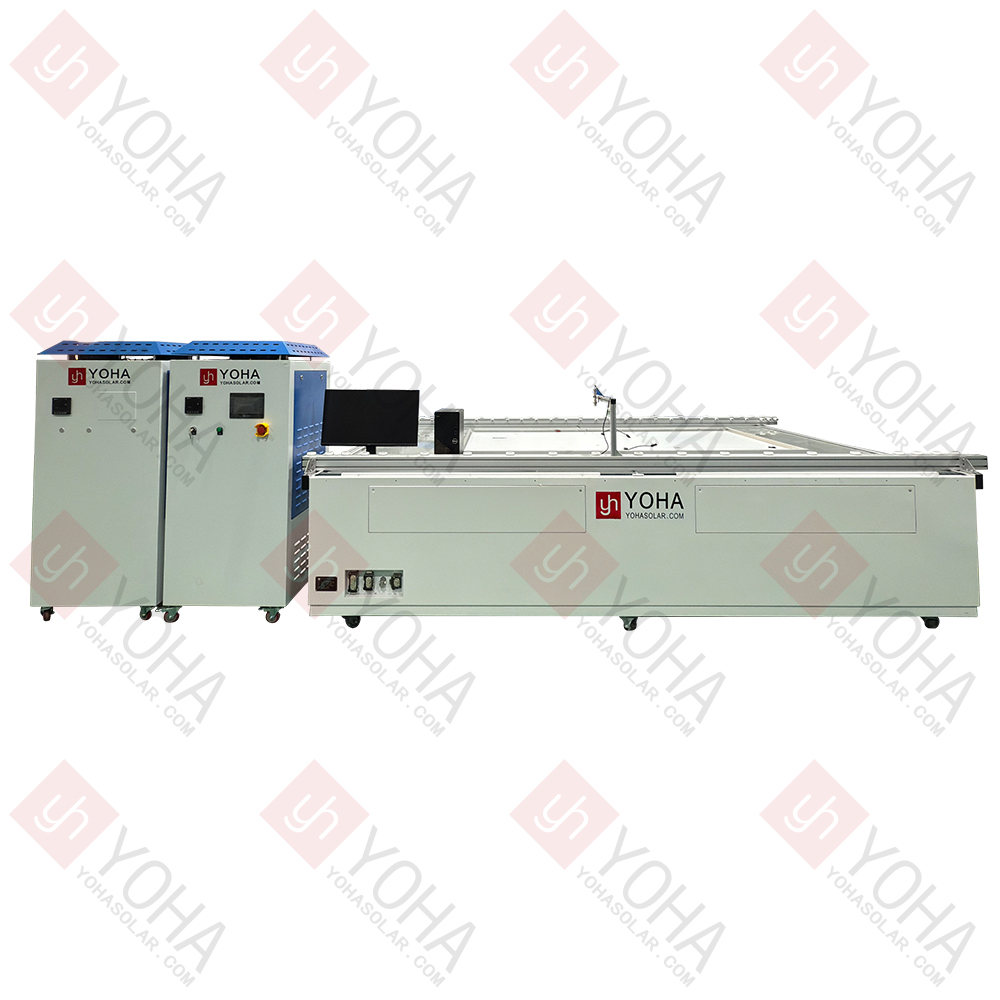
Under Standard Test Conditions, a solar simulator is used to precisely measure the output characteristics of the module. Key parameters include:
Maximum Power (Pmax): The core indicator of a module's generating capacity.
Open-Circuit Voltage (Voc) and Short-Circuit Current (Isc): Key electrical parameters determining system design.
Fill Factor (FF): Reflects the condition of series and shunt resistances within the module, an important basis for judging the quality of its manufacturing process.
Accurate electrical performance testing ensures each module delivers its intended value within the system.
3. Environmental Reliability Testing: "Accelerated Aging" Simulating Harsh Years
This is the most technologically advanced part of the testing system and best reflects the long-term quality of modules. Laboratory equipment simulates and accelerates the harshest environmental challenges found in nature.
Damp Heat Test: Subjects modules to high temperature and high humidity, testing their resistance to hydrolytic degradation, and evaluating the barrier properties of encapsulants/backsheets and the module's resistance to Potential Induced Degradation.
Thermal Cycling & Humidity Freeze Tests: Through rapid temperature changes, these tests challenge the compatibility of thermal expansion coefficients between different materials (e.g., glass, EVA, cells, metallic interconnects), exposing potential weaknesses that could lead to micro-cracks or solder joint failures.
Mechanical Load Test: Simulates static loads like snow and wind pressure, verifying the mechanical strength of the module and its structural durability after installation.
UV Aging Test: Evaluates the anti-aging performance of polymer materials like encapsulants and backsheets under prolonged ultraviolet radiation, preventing yellowing and embrittlement.
4. Non-Destructive Precision Flaw Detection: "Keen Insight" for Internal Hidden Dangers
Some defects are hidden deep within the module, invisible to the naked eye. This requires more sophisticated non-destructive testing techniques.
Electroluminescence (EL) Imaging: Currently the most widely used and effective method for detecting internal defects. When current is passed through the module, the crystalline silicon cells emit near-infrared light. Using a high-sensitivity camera to capture EL images allows clear identification of issues like cell micro-cracks, broken fingers, black cores, fragments, poor soldering, and shunting problems. A healthy module exhibits a uniform bright EL image; any defect causes variations in luminescence intensity, appearing as light or dark areas in the image.
Infrared (IR) Thermography Inspection: While the module is operating, an infrared thermal imager captures its temperature distribution. Defective areas (e.g., hot spots) generate localized heat due to increased resistance, appearing as abnormal hot spots in the thermal image. This is highly effective for identifying consistency issues and poor contacts within the series circuit.
III. Technological Development and Future Trends: Smarter, More Precise, More Proactive
As PV technology rapidly evolves, testing technologies are also continuously advancing.
Automation and Intelligence: AI and machine learning-based visual recognition systems are gradually replacing traditional manual inspection, achieving higher speed, accuracy, and consistency in analyzing EL images and judging visual defects.
Integration of In-line Inspection: Integrating testing equipment into production lines enables real-time monitoring and quality feedback during the manufacturing process, shifting from "post-production inspection" to "in-process control," effectively improving production yield and efficiency.
Targeted Testing for New Materials and Structures: Developing more targeted testing methods and standards for new technologies like bifacial modules, HJT, and Perovskite, ensuring the reliability of these innovative products.
Conclusion
PV module testing is far from a simple pass/fail judgment. It is a systematic engineering effort, an interdisciplinary field integrating materials science, electronic engineering, physical chemistry, and data science. It represents reverence for product quality, responsibility for customer investment, and a commitment to the sustainable development of the green energy cause. Choosing PV modules that have undergone strict and comprehensive testing is akin to installing the most reliable "safety lock" for the lifecycle revenue of a PV power plant. As a company deeply rooted in this field, we are consistently dedicated to advancing the innovation and application of testing technologies. With the most rigorous attitude and advanced methods, we strive to safeguard the energy conversion of every ray of sunlight, contributing to the construction of a more stable and efficient green future.