In the field of photovoltaic manufacturing and quality control, the solar module IV tester plays an irreplaceable role. It is the "touchstone" for inspecting the power generation capacity of PV modules, the ultimate gatekeeper ensuring that every module leaving the factory meets design standards and customer requirements. So, how does this crucial equipment work, and what sophisticated technologies and standards underpin it? This article comprehensively analyzes the principles, key parameters, and industry applications of the solar module IV tester, unveiling the secrets behind its precise measurements.
I. What is a Solar Module IV Tester?
Simply put, a solar module IV tester is a precision instrument specifically designed to measure and plot the current-voltage characteristic curve of a photovoltaic module. This characteristic curve, known as the I-V curve, is the most fundamental and critical basis for evaluating PV module performance. By analyzing this curve, we can directly obtain the core performance parameters of the module, including:
Maximum Power Point (Pmax): The maximum power the module can output, which is key to determining its power class and price.
Open-Circuit Voltage (Voc): The terminal voltage of the module under no-load conditions.
Short-Circuit Current (Isc): The current flowing when the module's output terminals are short-circuited.
Peak Voltage (Vmp) and Peak Current (Imp): The voltage and current values at the maximum power point.
Fill Factor (FF): A parameter measuring the "squareness" of the module's output characteristic curve; a higher value indicates superior module performance.
Without the solar module IV tester, determining the power rating of a module would be impossible, and quality assurance would be unattainable.
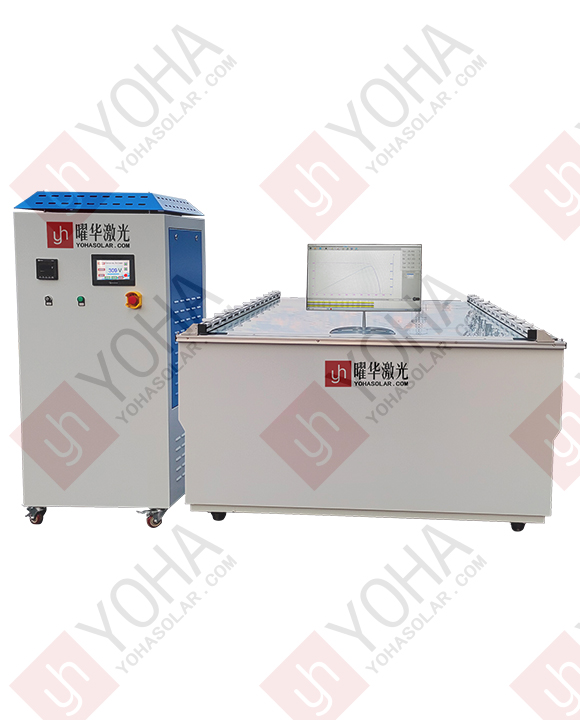
II. Core Working Principle and Technical Composition of an IV Tester
The operation of a high-performance solar module IV tester is a precise process integrating optics, electronics, and software algorithms. Its core lies in simulating sunlight and rapidly and accurately capturing the module's electrical response.
Solar Simulator – The Artificial Sun
One of the core components of a solar module IV tester is the solar simulator. It uses xenon lamps, LEDs, or other light sources to simulate the spectrum, irradiance, and uniformity of natural sunlight. International standards classify solar simulators into three classes: A, B, and C. Class A simulators offer the best performance in terms of spectral match, irradiance non-uniformity, and temporal instability, making them the essential choice for high-end manufacturing and precise power binning. A high-quality solar module IV tester must be equipped with a high-performance solar simulator to ensure testing conditions align with Standard Test Conditions.
High-Speed Data Acquisition and Electronic Load
During the instant the simulator flashes (typically lasting milliseconds), the precision electronic load inside the solar module IV tester rapidly scans the Device Under Test from open-circuit voltage to short-circuit current. Throughout this process, a high-speed data acquisition card synchronously records instantaneous voltage and current values at a very high frequency, thereby plotting the complete I-V characteristic curve. The speed and accuracy of this process directly determine the reliability of the test results.
Environmental Parameter Monitoring and Compensation
Module performance is significantly affected by temperature. Therefore, professional solar module IV testers integrate temperature sensors to monitor the temperature of the module backsheet or cells in real-time. The testing software compensates the I-V curve to the standard temperature (25°C) based on the measured temperature value and according to standard algorithms, thereby eliminating test deviations caused by temperature fluctuations and ensuring data comparability across different times and locations.
III. Key Metrics for Judging a High-Quality IV Tester
When selecting a solar module IV tester, the following technical indicators are core to evaluating its performance:
Testing Accuracy and Repeatability: This is the most fundamental metric. Measurement accuracy for maximum power is typically required to be better than ±1%, with repeatability better than ±0.5%. This directly relates to the accuracy of power binning and customer trust.
Solar Simulator Class: Prioritize equipment equipped with a Class A solar simulator, as it ensures initial testing accuracy from the light source itself.
Flash Pulse Characteristics: The pulse width must be sufficiently long to ensure the module is fully excited and the entire I-V curve scan is completed; simultaneously, the pulse stability must be high to avoid introducing measurement errors.
Data Acquisition Speed and Resolution: Higher acquisition speed and resolution capture a smoother, more realistic I-V curve, which is crucial for accurately pinpointing the maximum power point, especially near the curve's knee.
System Integration and Automation Capability: Modern production lines require solar module IV testers to seamlessly integrate into automated lines, featuring capabilities like automatic loading/unloading interfaces, barcode scanning, and automatic data upload to Manufacturing Execution Systems, enabling intelligent, traceable full-process control.
IV. Core Applications of IV Testers in the PV Industry Chain
The application of solar module IV testers spans the entire lifecycle of PV modules.
End-of-Line Production Testing: This is its most widespread application scenario. In the final step after module encapsulation, every module must undergo 100% testing by the IV tester. Based on the results, modules are power-binned, labeled, and provided with a unique quality certificate.
R&D Laboratory and Certification: In the development of new materials, processes, and module structures, R&D personnel rely on high-precision IV testers to evaluate the effectiveness of technological improvements and provide key data support for obtaining international certifications like IEC and UL.
Power Plant Incoming Inspection and O&M: During the construction of large-scale PV power plants, owners or third-party organizations use portable or mobile IV testers to perform sampling inspections on delivered modules, verifying that their power output matches the factory reports, thereby safeguarding investment returns. During plant operation and maintenance, periodic testing is used to assess module performance degradation.
Conclusion
In summary, the solar module IV tester is far from being a simple piece of testing equipment. It is the cornerstone of the photovoltaic industry's quality system, the bridge connecting manufacturing to performance promises. From dedicated R&D in laboratories to efficient output on production lines, and reliable operation in the field, its precise data remains the sole benchmark for measuring value and quality. Investing in a technologically advanced, stable, and internationally standards-compliant solar module IV tester is not only a choice for enhancing production processes and control capabilities but also a long-term investment in brand reputation and market competitiveness.