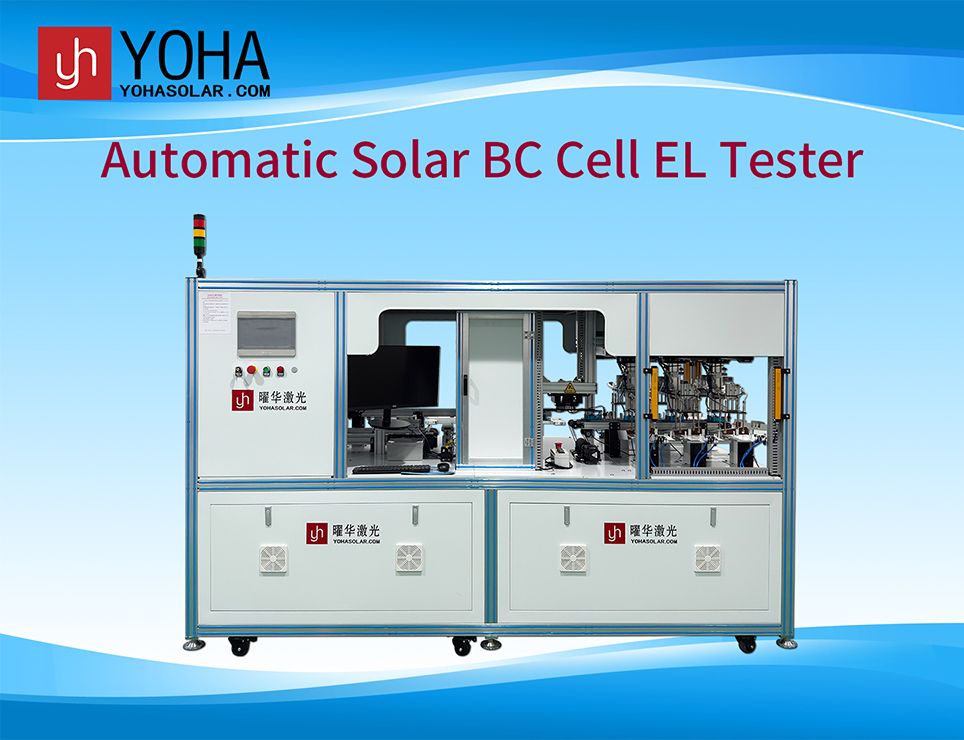
| How to Locate Internal Defects Through EL (Electroluminescence) Testing During t |
| 发布时间:2025-09-12 11:48:50| 浏览次数: |
In the field of photovoltaic module manufacturing, quality control is a core aspect of ensuring long-term product reliability. Among various techniques, electroluminescence (EL) testing has become an indispensable high-precision diagnostic method for locating internal defects in solar cells. So, how is EL testing used during the production process to locate internal defects? How does this technology uncover the tiny flaws hidden inside modules? This article delves into its principles, processes, and value. Basic Principles of EL Testing To understand how EL testing locates internal defects during the production process, it is essential to first grasp its working principle. EL testing is a non-destructive detection method based on the inverse process of photoelectric conversion. When a forward bias is applied to a photovoltaic module, charge carriers are injected into the PN junction of the cell, and these carriers emit near-infrared light with a wavelength of approximately 1150 nm upon recombination. By capturing this luminescence with a high-sensitivity camera, an image of brightness distribution is obtained—areas with high luminescence intensity indicate well-performing cells, while dark areas, black spots, or abnormal streaks suggest potential defects.
The ingenuity of this detection method lies in its ability to convert electrical characteristics into visual images. Locating internal defects through EL testing during the production process essentially involves analyzing the unevenness of luminescence images to infer abnormalities in silicon wafers, welding processes, or material structures. Testing Process and Implementation Steps Throughout this process, the key technical challenge lies in balancing detection speed and image quality. Modern production line-integrated EL systems use cooled CCD cameras paired with large-aperture optical lenses, enabling imaging of full-size modules in just 10-15 seconds with resolutions reaching megapixel levels, ensuring the ability to identify micron-level defects. After software processing, the images are compared with preset standards, automatically marking abnormal areas and classifying defect types. Defect Types and Image Characteristics Microcracks and Cracks: Appear as thin linear or网状 dark patterns, resulting from mechanical stress during silicon wafer cutting, welding, or lamination. EL images can clearly show the direction and length of cracks, even distinguishing between new and old cracks. Fragments and Missing Corners: Manifest as geometric dark areas at edges or corners, usually caused by handling collisions or improper operational processes. Welding Defects: Include virtual welding, over-welding, or ribbon displacement, appearing as localized dark spots or regular streaks in EL images, directly affecting the current collection efficiency of the cell. Inherent Material Defects: Such as silicon impurities, grain boundary errors, or potential-induced degradation (PID) effects, often presenting as scattered black spots or large dark areas. Locating such internal defects through EL testing during the production process allows for timely adjustment of process parameters, controlling quality at the source. Micro-Short Circuits and Leakage: Abnormal bright spots or edge bright bands often indicate the presence of leakage pathways. Although rare, such defects are extremely harmful, and EL testing is one of the few methods capable of effectively identifying this issue. Technical Advantages and Industry Value For manufacturers, online EL testing enables 100% full inspection, significantly reducing the risk of missed defects. By integrating EL systems into key stations such as after string welding, before lamination, and final testing, defects can be intercepted at different stages: post-string welding detection promptly identifies cell cracks and welding issues; pre-lamination detection prevents defects from entering subsequent high-cost processes; and final testing ensures zero defects in finished products. This multi-node monitoring strategy greatly enhances process control levels, reducing material waste and rework costs. Technical Challenges and Innovation Trends Current technological innovations primarily focus on artificial intelligence and high-speed imaging. Deep learning-based image recognition algorithms can automatically classify defect types and predict their risk levels, significantly improving detection efficiency and accuracy. Additionally, the integration of multispectral EL technology and thermal imaging further enhances the dimensionality of defect diagnosis, enabling the distinction between structural defects and performance-related defects. Conclusion |
| 上一篇:What Is the Manufacturing Process of Solar Panels? 下一篇:How to Trace Virtual Welding or EVA Encapsulant Film Bubbles in the Welding Proc |